A travelogue by Professor Cristina Murphy, the curator and coordinator of the trip.
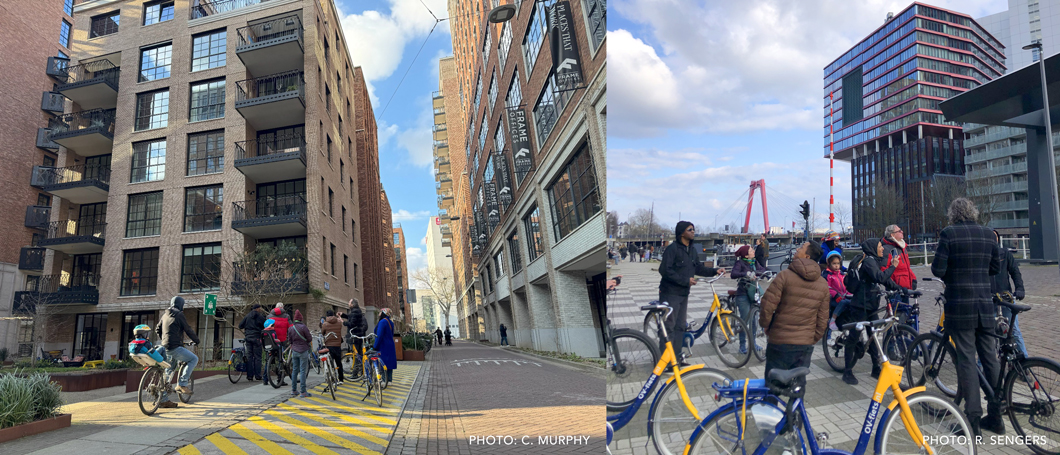
| In March 14–21, 2025, students from Morgan State University’s School of Architecture and Planning embarked on an eye-opening study abroad journey through Amsterdam, Rotterdam, Antwerp, and Delft—an immersive educational experience led by Professor Cristina Murphy. The week-long trip offered students the opportunity to witness firsthand how European cities are tackling pressing urban challenges through sustainable design, participatory planning, and community-centered innovation. A trip report is below. A shorter version of this article is available on Morgan State University’s website. The students were joined by three community planners from the Baltimore City Department of Planning (described on another webpage), and several design professionals. This trip was part of a 2-way Baltimore-Rotterdam exchange in 2025. |
MARCH 14: AMSTERDAM
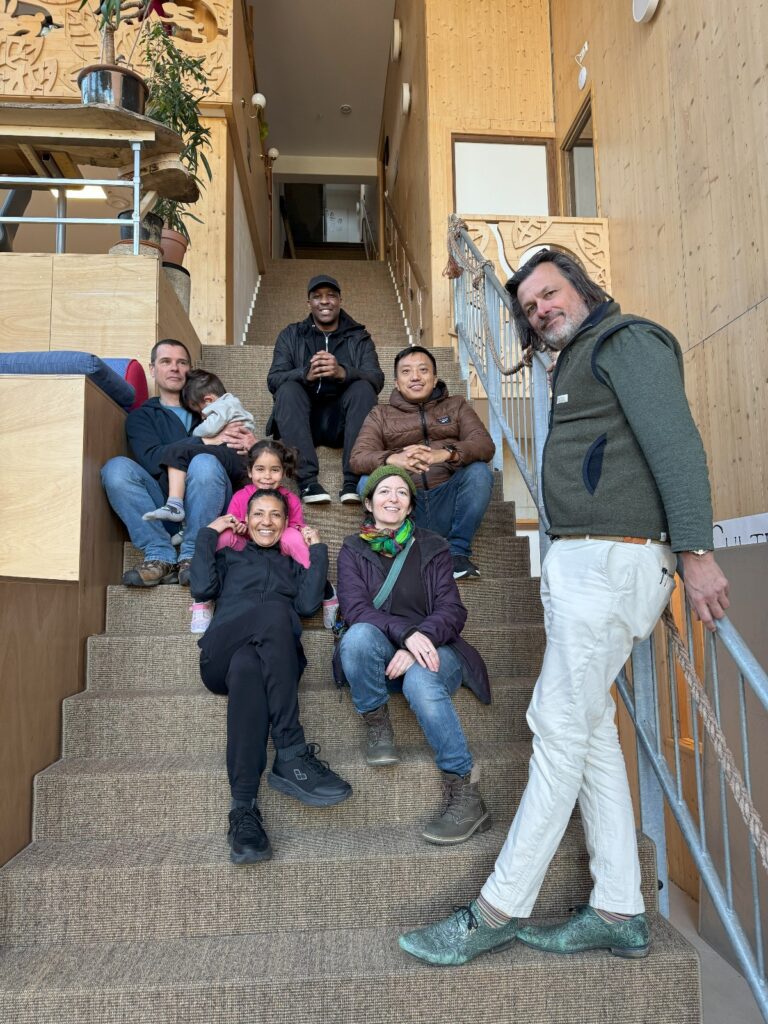
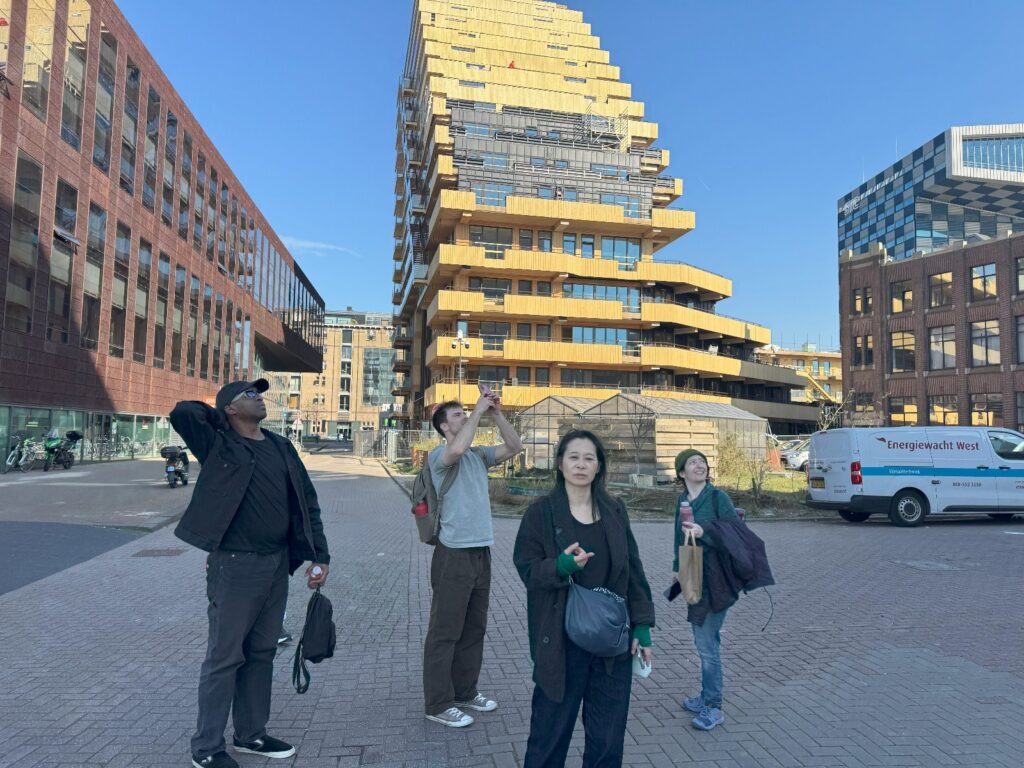
Visit to De Warren, a
cooperative housing project in Amsterdam designed by Natrufied Architecture.
(Photo: CCM)
Walking to De Warren was an experience in itself. Amsterdam is growing and conquering the water. Centrumeiland, “Centre Island,” is a newly raised piece of land on Lake IJmeer. The island will accommodate 1,200 to 1,500 new houses and adopt the “Rainproof” strategy, a plan involving the collection, utilization, and drainage of excess rainwater.
De Warren is a cooperative housing project consisting of 36 apartments and a series of common spaces for 20 tenants. At the center of this project is the idea of providing social and affordable rental units for a group of like-minded friends who, in 2020, decided to come together and create a cooperative, De Warren, obtaining a 30-year mortgage, acquiring land, hiring an architect, and collaborating in the construction of a sustainable building. The authentic ideas behind this building are numerous: this group formed their cooperative out of necessity, unable to sustain Amsterdam’s high rents or obtain individual mortgages; their determination led to record actualization despite intensive workshops and engagement sessions; although they hired a general contractor, they worked intensively on-site by providing supplies and physically laboring together; thirty percent of the program consists of shared/communal areas. The building functions as a mini-village that sustains a small community; the building is energy-neutral, energy- producer, and rainproof. Particular attention was paid to material choices, maximizing energy production for heating and electricity, and collecting organic waste, socially, it represents a microcosm of 20 friends who live together and care for each other, the green facades and garden roof welcome insects and birds to eat and nest within its structure; since individuals don’t own the building but rather the cooperative does, it doesn’t follow market-based financial speculations.
Although this is a relatively established social and affordable rental housing concept in Sweden and Germany, De Warren is the first building that operates this way in the Netherlands. Aesthetics were not the priority because the result embodies the intense collective desire of a group of people who developed and manage, together, a building they all call home.
MARCH 15: ROTTERDAM
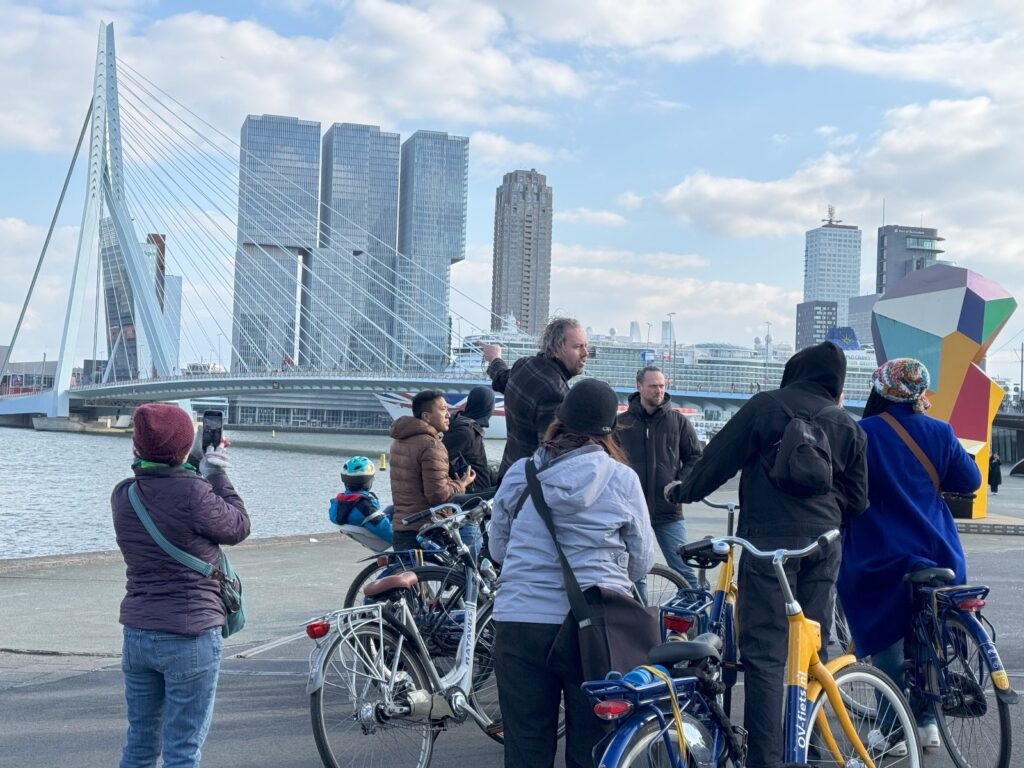
By the Maas River, looking at De Rotterdam (Photo: CCM)
Today, despite some delays, we departed from Rotterdam Central Train Station for a bike ride around the city. Our ambition was rather high. What we actually accomplished was half of our aspiration – a total of 7.71 miles in 4 hours. Several factors contributed to this change of plan, which Emiel Arends, Senior Advisor on Urban Affairs with the City of Rotterdam and our guide, described as “plan D”: participants’ initial challenges with rental bikes, necessary caffeine intake, and the wind. Yet we persevered and, in my humble opinion, made a great day of it.
The current design for the Central Train Station – including a spacious and well-designed square on the city center side – was conceived in 2004, when ProRail, NS, and the Municipality of Rotterdam awarded the project to Team CS, a cooperative consisting of Benthem Crouwel Architekten, MVSA Meyer & Van Schooten Architects, and West 8. The space accommodates a multitude of events. For us today, it served as the perfect training ground to practice biking and stopping with coaster brakes.
Our first stop was at the Water Square by De Urbanisten. This is the first of a series built in the city and has served as a testing experience for design improvements. Although it is the most complete and ambitious in terms of amenities (square, bleachers, skateboard park, basketball court, water garden, etc.), the ramps leading to the pit were designed too tight, preventing cleaning machines from navigating the curve to reach the lower level. As a consequence, the square is poorly maintained and stained with algae – a normal phenomenon when spaces are frequently humid and/or submerged. Despite this and the chilly weather, young people were populating the space and having a great time!
Just a few steps away, we entered ZOHO Maakkwartier, an area the city has used as a testing ground. Only 5 minutes from the city center, ZOHO is a place to live and work. I remember when I spent most of my days at the Office for Metropolitan Architecture (OMA), which was located at the edge of the site at that time. I recall many innovative projects initiated by the opportunity to reconnect areas and the necessity to guarantee residents a better quality of life. Historically an industrial area, Zomerhofkwartier was for long a segregated and impoverished neighborhood that struggled with vacancies.
Hofbogen is the gigantic suspended infrastructure in the area. The plan for this unused high rail is to transform it into a 2 km (1.24274 mi) pedestrian green boulevard and a hub for amenities catering to the community such as food, arts, culture, and education. Currently, Hofbogen is experimenting with spaces at street level, accommodating various programs and opening the higher level to Dakdag (roof day) and to informal grassroot organizations maintaining it through urban gardens and parks.
In 2015, the city launched a crowdfunding event to support a grand concept addressing the challenge of connecting the center of the city (of which Hofplein was one edge) with Rotterdam North (of which Hofbogen wasa barrier). ZUS architects won the contest and built Luchtsingel, a staircase and bridge allowing citizens to cross undesirable vehicular intersections and safely reach both sides. After 10 years of great success in proving that this connection is needed, this temporary structure will become a permanent element of the city. The plan is to formally connect these urban areas and extend the city boundary through a suspended park designed by De Urbanisten (Hofbogenpark).
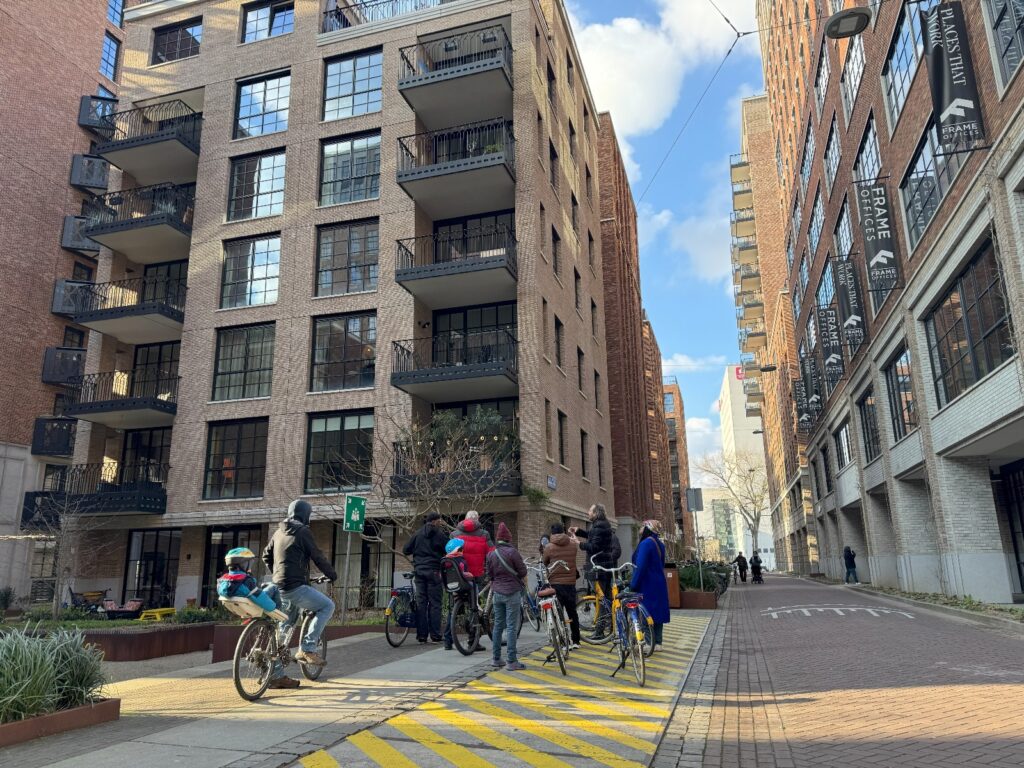
We biked around the corner from Heer Bokelweg and stopped by the back entrance of the “Stover” housing complex to see if we could spot woonerven. Cities and mobility are significant themes: often, urban spaces prioritize cars and fast-speed movement through residential and recreational areas that should be more enjoyable for residents to walk and stay in. In the 1970s, Herman Hertzberger recognized the opportunity for most urban streets to become woonerven (residential streets) with mixed-use programs and users (Gameren et al., 2010). Through this process, people became the benchmark for the scale of streets, squares, meeting places, and design elements. This was a response to the demand for public space as a living domain.
After a brief coffee break, we headed down to Hoogstraat, Rotterdam’s oldest street, that, during the pandemic, changed its layout to accommodate less traffic and more pedestrian and bike movement through the introduction of green parklets.
We then reached the Blaak. Here, Emiel described the importance of the site, the Cube Houses, the Public Library, the “farmers” market and, of course, Markthal by MVRDV. We briefly discussed the ambitious concept for the building, the vital importance of the market, the real estate value of the area, temporary voids and/or green spaces for residents, and the soon-to-be-constructed green “band” which will wrap the site and provide a lush extended urban park.
We moved south from Blaak into Wijnhaven and, while standing by CasaNova, reflected on Rotterdam’s high-rise culture. Designed by Barcode Architects, CasaNova is a set of two high-rise mixed-use buildings sharing amenities and services. Located on top of a 30-meter (9,8500 ft) plinth, the two towers look quite different while serving the same purpose: reconnecting Wijnhaven to the city center through residences and amenities. Thanks to the plinth accommodating much of the shared programs, both towers remain slender and essential. The plinth, containing public and semi-public services, supports the urban culture of bringing vitality and purpose to the streets.
Moving to the waterfront was adventurous due to the wind. Once we arrived at the Erasmus Bridge, we admired the view, a spectacular city skyline that never gets old. Biking along the harbor and into Het Park was relaxing and allowed the group to savor the various scales of this city.
The last venue of the tour was Little C (Coolhaven), designed by CULD + Juurlink [+] Geluk. Once again, the intention was to reconnect yet another remote urban area with the city center and, in this case, with the water. The plot is small and densely mixed-use, and the designers were not only charged with creating a new urban neighborhood retaining the original “warehouse” charm of the past. They were also held responsible for redistributing public and accessible space back to the citizens.
MARCH 16: ANTWERP (IN BELGIUM)
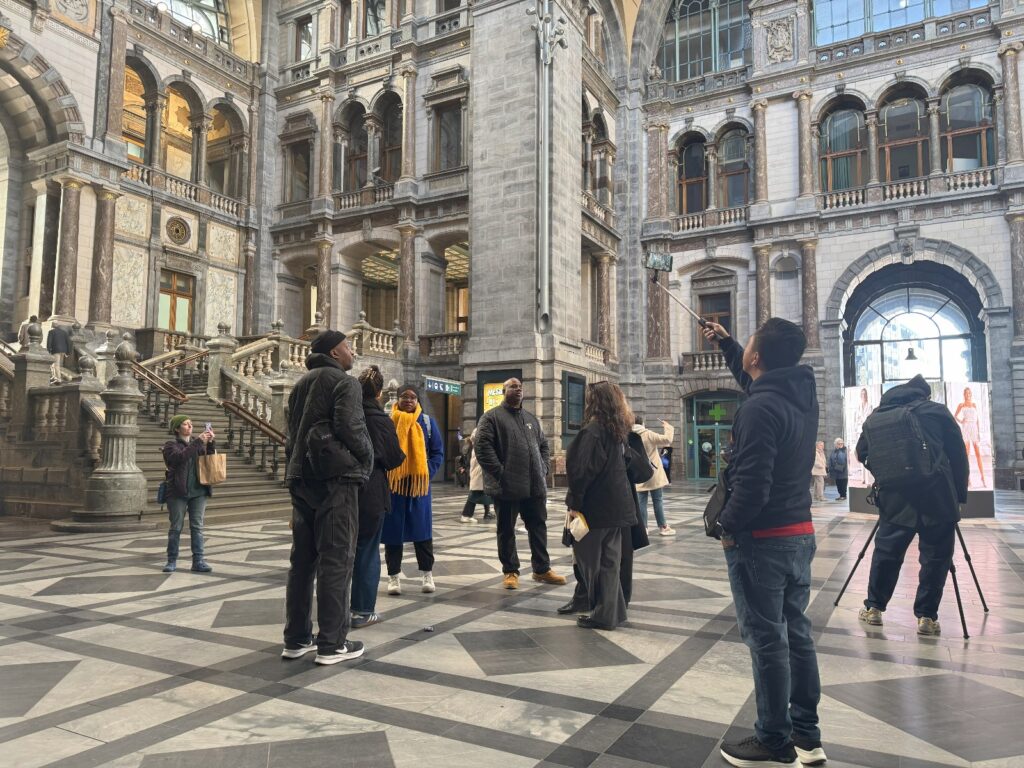
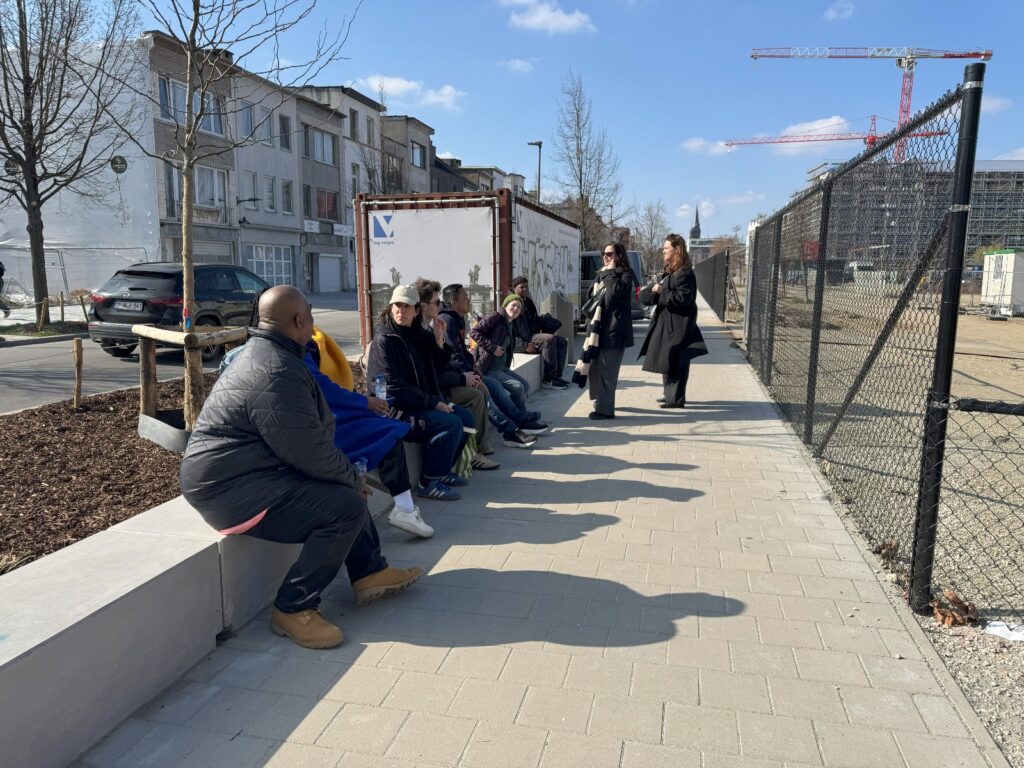
Despite the construction work slowing down rail traffic, we made it to Antwerp today. Here, we met Sophie Leroy and Caroline Thaler from Endeavour who were so kind as to accompany us for over 4 hours, covering a 6-mile walk around the city. Our focus was Antwerp Noord, a complex area of the city center that, in recent years, has undergone significant physical transformation of places and social displacement of people.
Antwerp, Belgium’s second largest city, hosts a substantial immigrant community; 13% of the city’s population consists of foreigners, of whom 8% are non-EU nationals. Since 2001, the city has registered an influx of new inhabitants contributing to a positive birth rate. The considerable non-Belgian presence in Antwerp stems from global migration patterns and the harbor’s economic activities. Naturally, the concentration of diverse nationalities within city boundaries has created tensions about the multicultural society, perceptible at all levels of urban life. Within this context and despite these conflicts, the city government’s political agenda aims to ensure Antwerp remains livable where everyone accesses basic rights. Simultaneously, officials acknowledge lacking crucial tools for implementing consistent diversity policies, with dependence on many higher government bodies.
Our tour began at Central Station. From there we walked to the Permeke Library, where Endeavour supports the “Feminine City” garden. This square, once situated outside the first medieval walls, hosts a Sunday book market. The area faces challenges of social and infrastructural integration. Following urban renewal strategies, this area is gradually transforming. One notable new project is the Library, which has established a garden dedicated to women’s gathering, information, and empowerment. Endeavour’s project provides women a weekly meeting space every Thursday. Here, they have co-created a green sanctuary with flowers, vegetables, and herbs while developing ideas about public space and women-friendly environments within the city. Women share stories and talents, feel safe, and engage in teaching and learning. Women come from various parts of the city for these Thursday gatherings. The garden closes at night. Given this place’s success, replicating the concept closer to these women’s homes with extended daytime access should be prioritized. However, such co-creation requires coordinating vacant lots, facilitators, and participants. The garden radiates enthusiasm and empowerment. Women feel safe and confident, though no one commits to specific activities. While this might appear to hinder the place’s evolution, it actually liberates participants from preconceived ideas they didn’t help create initially.
Walking toward Slachthuis, we traversed highly commercial streets offering diverse products. We appreciated the variety of people, goods, and cultures creating vibrant streetscapes. This area, predominantly social housing, is transforming into a speculative real estate market. After crossing the train tracks, we noticed houses becoming larger and amenities less diverse but more expensive.
At Slachthuis, we learned the warehouses are becoming schools and community spaces including parks and playgrounds. Throughout the area, the city renovation plan involves new housing structures, extensive renewal of existing buildings, and enhanced street amenities. These developments target young families and students, bringing different energy to the neighborhood. A central, well-programmed park has united the community, with various local associations collaborating with the city to advocate for such essential community hubs.
From here, we entered Park Spoor Noord, formerly a railroad that underwent massive renewal between 2012 and 2017. The community engages here through various activities: basketball, cricket, playgrounds, sandpits, and teen gathering spaces. Renovated warehouses now house indoor skating and climbing facilities. We are witnessing systematic gentrification: this park has always existed but only now truly serves its community through programs and services supporting the neighborhood’s recreational and educational needs.
Finally, we arrived at Wijk Eilandje, once a blue-collar district characterized by warehouses. Today, these same structures have become premium apartment buildings and services catering to high-income residents. Almost no trace remains of what was once a disconnected, dysfunctional part of town marked by crime and poverty.
MARCH 17: ROTTERDAM
HOGESCHOOL ROTTERDAM
At 10 AM we arrived at the Hogeschool Rotterdam located by Little C. Before entering the building, it was interesting to look back at the urban public space by the river Schie which we visited by bike on day 2 and observe how the space was used by students, residents and businesses on a busy Monday morning. Although much should be attributed to the sun, the urban square at the edge of the river was pulsing with vibrating energy from passersby, people hanging out, individuals busy working in and around buildings, solo runners, groups chatting, and students gathering by the entrance of the University.
Hogeschool Rotterdam, today renamed to University of Rotterdam for Applied Sciences, occupies diverse sites in Rotterdam, each with its own unique scale, program, and connection to the place and community it serves.
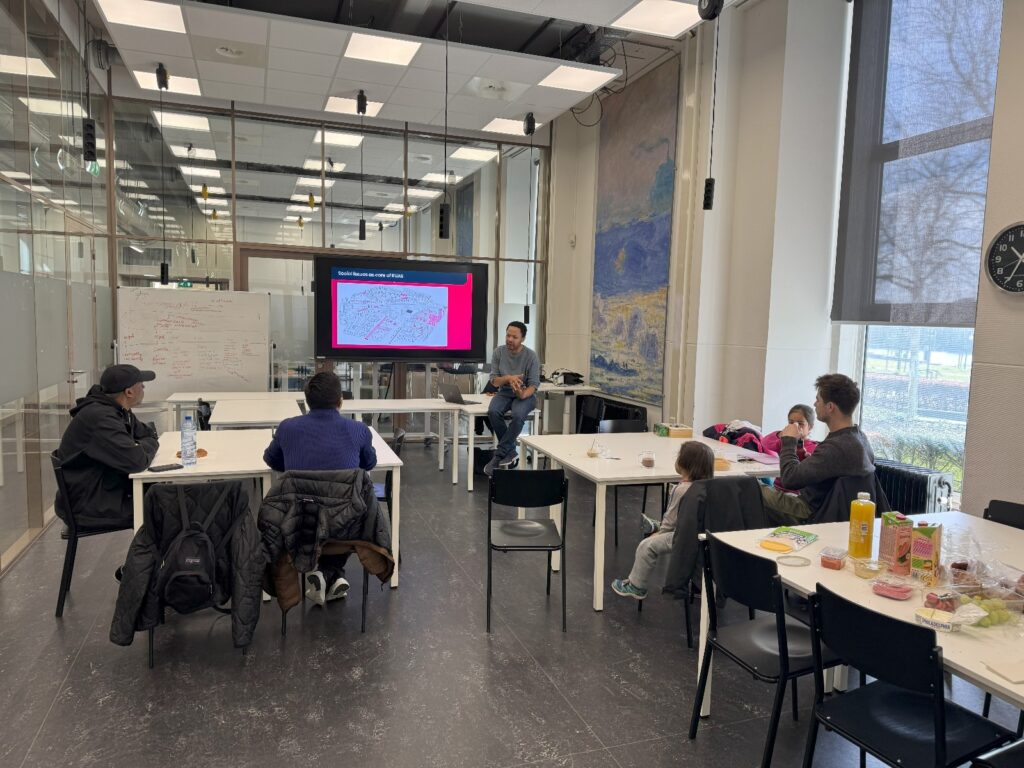
David ter Avest, Urban Geographer, PhD candidate, and instructor of Spatial Development, took us through the school’s current DNA and future ambitions.
(Photo: CCM)
Hogeschool Rotterdam is practice and execution-based, looking at the city as the ground in which all knowledge is shared, translated, cultivated, and developed. The city hosts the school, and the school’s curriculum is built up in a way that each class contributes to community engagement and participation.
Rather than looking at solutions and outcomes, students are trained to slow down, redefine and think about urban situations. Fundamental in the education are:
- Promises to the city: Understanding the scale and role of the Hoogeschool within the city and the many ways it can contribute to its social dynamics.
- Being there! Having many branches in the city allows the school to be a beacon, an institution that observes the city and reflects on its lively daily activities. The school functions as a community hub.
- Reciprocity: The act of giving back and getting from. Within the curriculum, students do not limit their interactions with residents through surveys and interviews but establish a systematic process of working together and, collaboratively, resolve daily challenges. Strong is the drive to work together while educating each other toward more transdisciplinary outcomes.
- Equality — connecting and merging: This implies that students within the city formulate theoretical and critical thinking but also practical and experiential knowledge that allows a full understanding of social situations and spatial dynamics. Everyone is an expert in understanding and providing equality.
- Continuity — stay there: The process of continuously learning and doing so together is key and supports the subsequent steps into applying and making. Students work with communities, and the next generation of students picks up from where the earlier class started and left off (learning sequence).
My takeaway from David’s lecture and introduction to the Hogeschool Rotterdam is that the education leading students to become functional professionals in the city is the realization that we are all built up from the knowledge that is already there! We are not creating anything new. Yet, we are leveraging knowledge that has been there and is there for us to learn from and roll into a new dimension. Starting any process from observing is key: looking at what is there, learning, and co-creating with the end users. If city designers use and consume the city like the most disadvantaged citizens, the necessity to improve the urban situation would expedite and things would progress much better. The users tell the story of accessibility and inclusivity.
KEILEPAND
Arriving at Keilepand was inspiring. The students biked along the Maas into Delfshaven, one of the few areas that survived Rotterdam’s 1940 bombing.
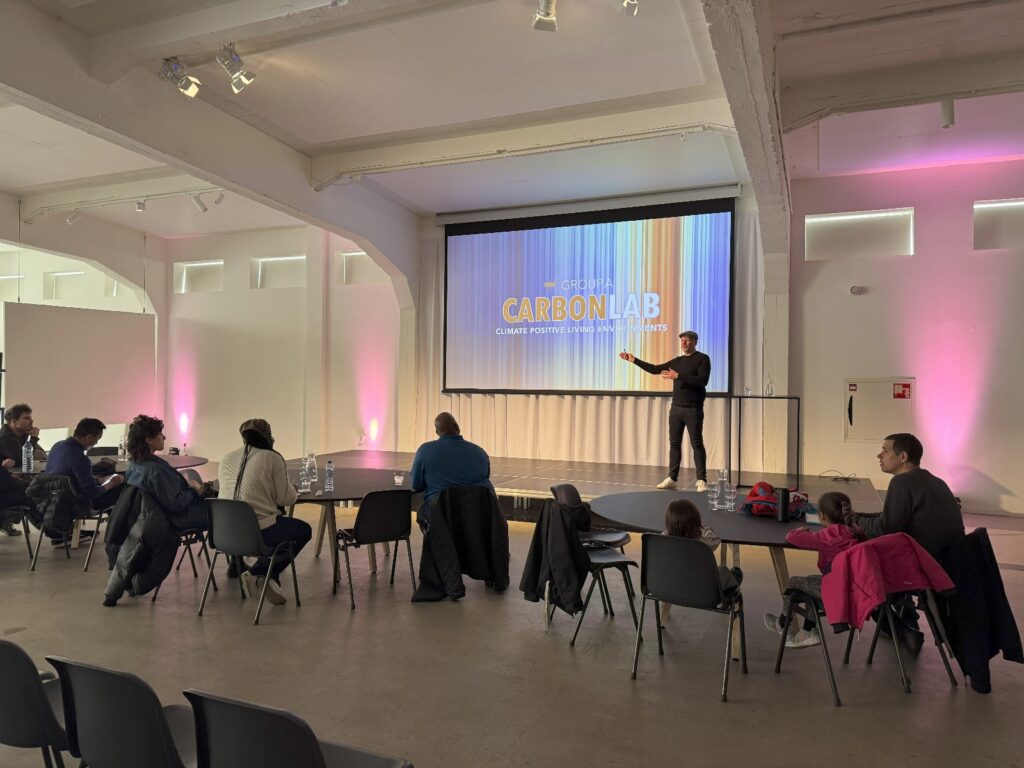
By 1 PM, we reached Keilepand, a repurposed warehouse in Merwe-Vierhavens (M4H), a district blending start-ups and multinational businesses to foster creativity, entrepreneurship, and technology. Home to De Urbanisten, an urban and landscape office, Keilepand exemplifies innovation through projects like the sponge garden and Tidalpark. M4H is a hub for the innovative manufacturing industry, serving as a testing ground for new products, technologies, and sustainable practices.
By 2050, M4H will see the construction of around 5,000 homes within the Makers District, potentially displacing existing communities. Keilepand’s occupants aim to counter this by promoting collaboration between businesses, residents, and the local ecosystem, ensuring development enhances rather than replaces the area’s identity.
Keilepand, a massive concrete collective space, preserves historical architecture while fostering community cohesion. Transformed between 2015 and 2019 by GROUP A and studioADAMS, it has become a hub for sustainable innovation. Step by step, the building has been renovated to house a diverse array of businesses, actively contributing to the area’s transformation.
Rotterdam envisions M4H as a high-end, sustainable district, aligning with EU climate goals. By 2050, the area must be climate-neutral, in line with the European Green Deal. Achieving this requires energy-neutral design and sustainable practices, principles that drive GroupA/CarbonLab’s work at Keilepand. Material repurposing has also been central to the transformation, balancing innovation with heritage preservation.
Margaret Crawford (2008) wrote that “design within everyday space must start with an understanding and acceptance of the life that takes place there.” Keilepand embodies this by embracing existing realities and supporting community-led efforts to enhance Rotterdam’s vitality.
If co-creation involves engaging end-users in shaping their environment, GroupA/CarbonLab and De Urbanisten exemplify this approach, working with the community to improve and sustain the neighborhood. Their restoration of Keilepand has transformed an obsolete space into an inclusive, accessible hub, demonstrating the power of placekeeping – preserving a neighborhood’s essence while fostering growth and adaptation.
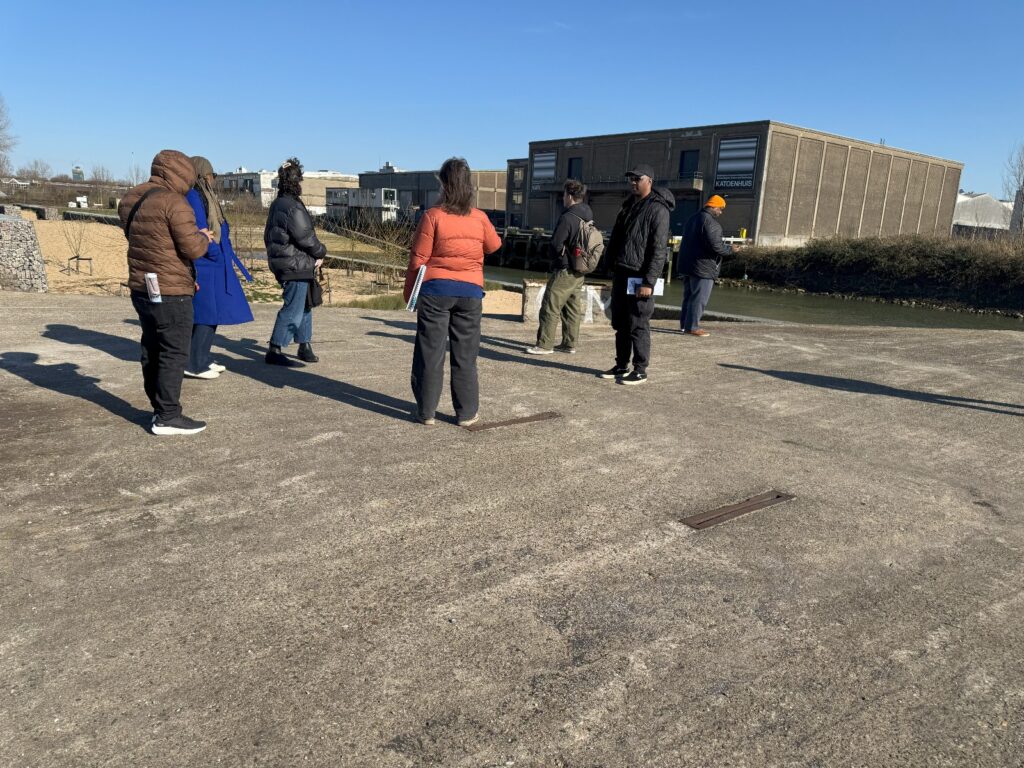
MARCH 18: DELFT
CO-WONEN
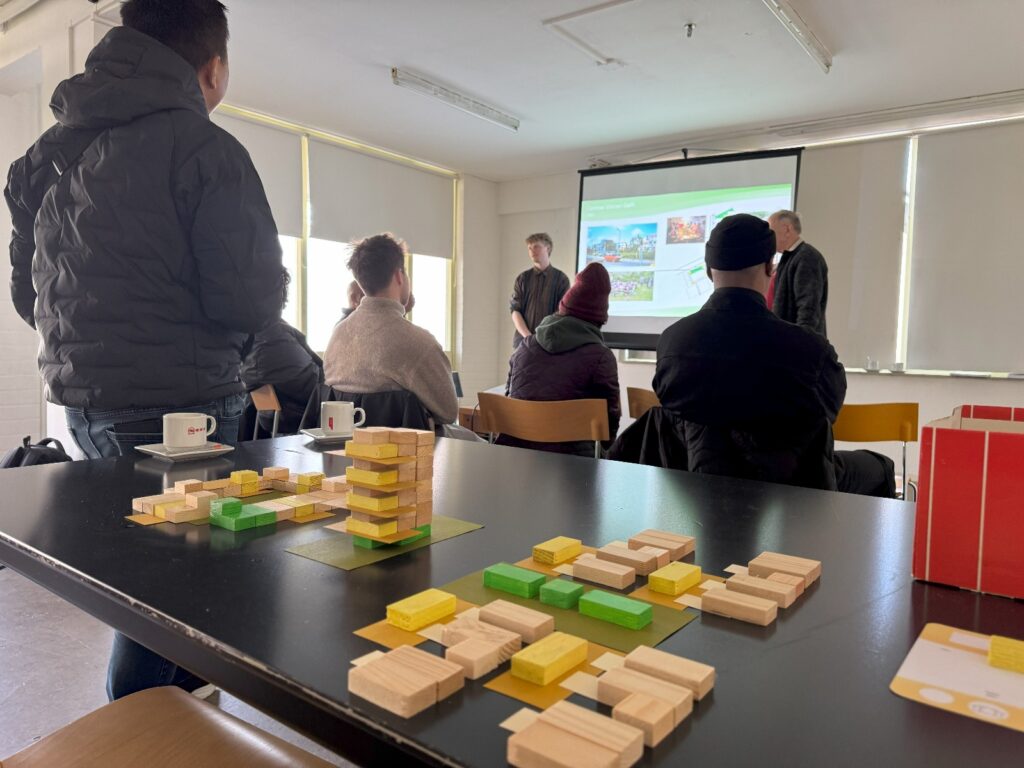
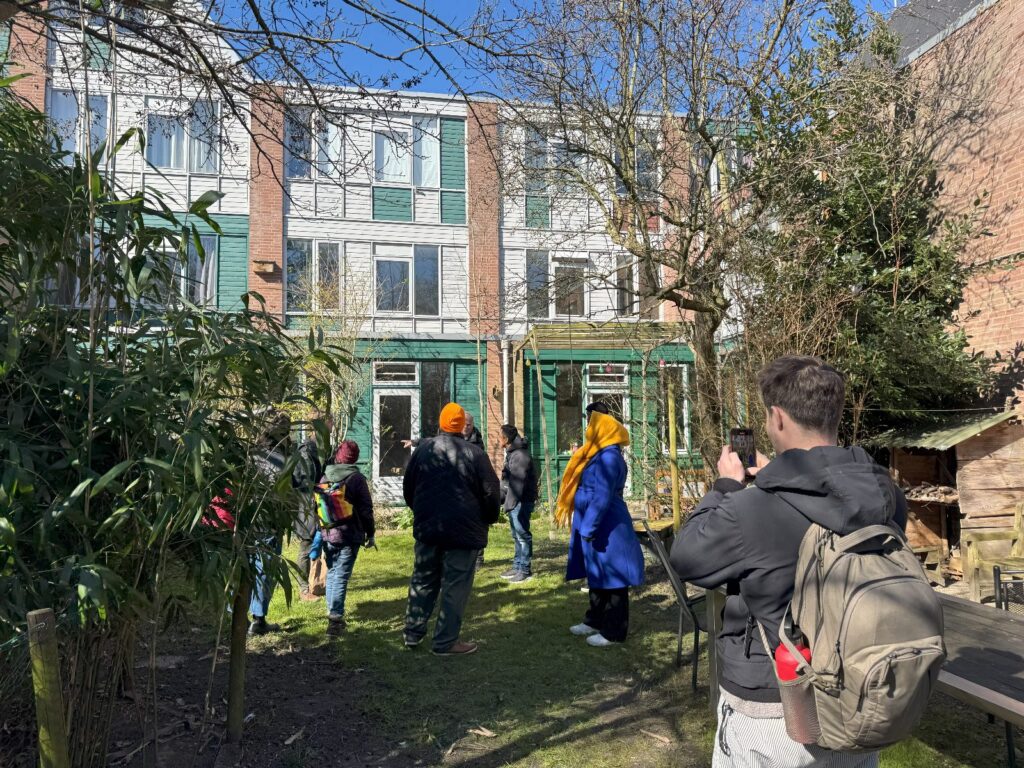
To address the question “How can we design co-housing to facilitate community engagement?”, we visited Co-Wonen, where Tijmen and Flip provided insights from their extensive experience with social and spatial negotiation in co-housing projects. Their 25-year age difference offered complementary perspectives: Flip, a retired architect with a PhD and longtime co-housing resident, and Tijmen, an enthusiastic architect focused on experimental approaches.
They walked us through the Dutch co-housing timeline, emphasizing that despite the growing need for more conservative and humble living arrangements, community members must be understood, encouraged, and empowered for co-design projects to become sustainable and successful.
The Dutch co-housing evolution spans centuries:
- Hofje van Bakenes in Haarlem (1395)
- Delft Garden City Social Housing
- Centraal Wonen in Hilversum (1977)
- Gemeenschappelijk Wonen Project in Nieuwgeinse (1982)
- Dutch squatters culture (1980s)
- Collective Self-Build (CPO) (2000s)
- Co-ops emergence (2015)
Co-Wonen now questions what future community combinations might look like. While historical co-housing often followed top-down organizational structures, today’s communities form through more complex and fluid dynamics, making design considerably more challenging.
This complexity has transformed traditional design into co-design—a collaborative creation process that seeks input from all users to ensure functionality and longevity. A key consideration is determining the appropriate balance between collective spaces and social interactions.
Motivations for co-housing:
- Aging populations seeking care solutions
- Rising housing costs
- City benefits (reduced burden on municipal services)
- Improved resident happiness and health
- Environmental advantages through shared spaces and reduced redundancy
Co-Wonen’s framework for successful community engagement centers on:
- Privacy
- Ownership
- Click (compatibility between residents)
- Casual Encounters
- Planned Interactions
- Social Continuity
Designing for such principles requires transition zones; engagement with shared spaces, and circulation is communication: we need to co-create spaces to linger and meet other people.
We concluded our visit with a tour of Flip’s community, which he helped design over 25 years ago, offering a living example of these principles in practice.
TU DELFT
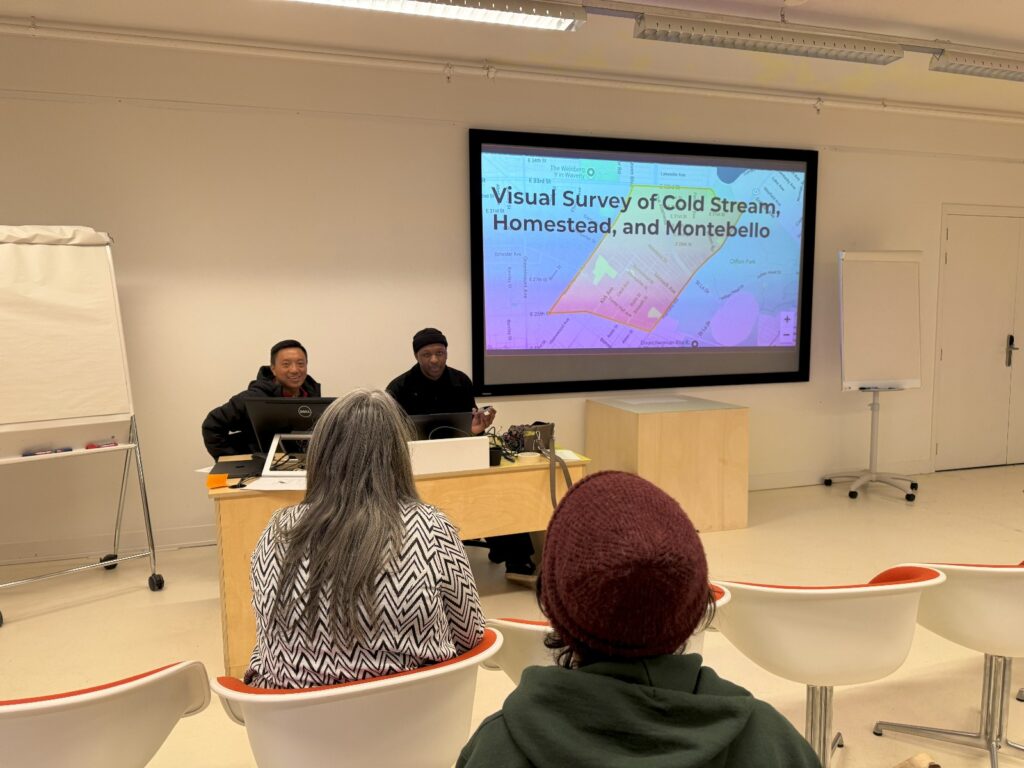
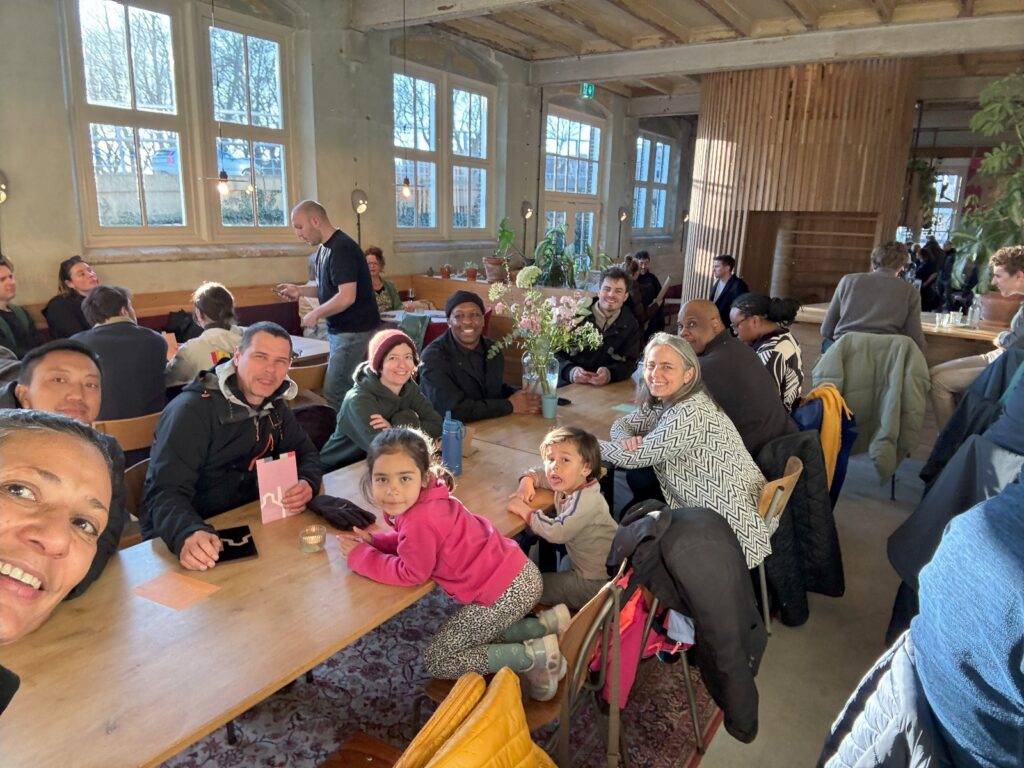
Crossing the Delft University of Technology campus, we arrived at the Bouwkunde (the Department of Architecture) and met with professors Fabiana Toni and Laura Cipriani.
Despite a rather frustrating technical delay, the Morgan team was able to present some ongoing work. Professor Cipriani shared her recent awarded project revolving around engagement, play, and landscape. Finally, Professor Rocco introduced the work been done at the Just City Center. Touching upon tangible, real, and urgent societal matters, Rocco shared his on-going research on understanding City dynamics consisting of spaces that, while they should be designed for people (and with people), prove to constantly fail our expectation and result in disastrous societal relationships and life qualities. At the core of his research is the exploration and promotion of urban justice and equity in city planning and development.
Finally, the group gathered at Vakwerkhuis, a mixed-used community-oriented placekeeping case study a few steps away from the University. Vakwerkhuis is an architecture office (Vakwerk Architecten), a cafe, and a gateway and a connection between the city center and the University of Technology Delft. The old boiler house, once the main source of energy for the University, remained silent for a while. Now it is a significant point of connection and encounter between students and residents of Delft.
MARCH 19: ROTTERDAM
CITY PLANNING PRESENTATIONS
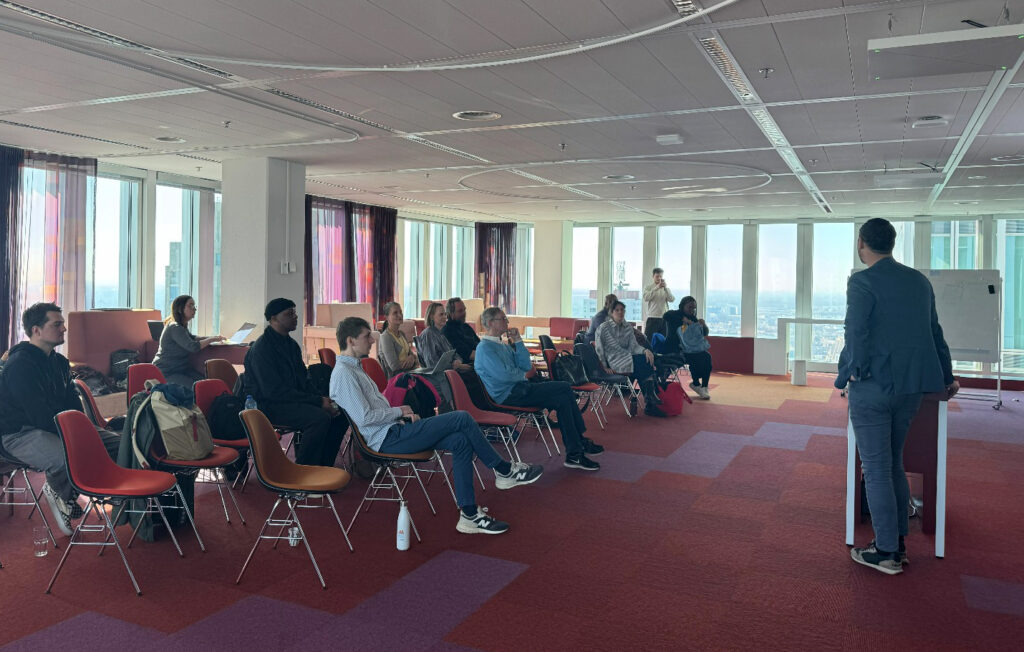
Rotterdam and Baltimore city planners provided presentations, with group discussion
(Photo: CCM)
After Hermen Borst, Director of Urban Development at the Municipality of Rotterdam, provided a formal introduction, delegates from the Baltimore Department of Planning presented to city delegates, students, faculty, Baltimore-Rotterdam Sister Cities Committee members and interested citizens.
Citing from Hermen’s opening session, we are aware of the fact that we do not know everything despite our education and worldwide experience, and that we must come together and co-design toward placemaking. This exchange among sister cities offers a moment to learn and share experiences, practical methods, and applications. The invitation is to mutually react to what we see and hear today because, without constructive feedback, we stop the knowledge flow from moving and disseminating across different and similar urban realities.
The initial hour was spent listing the innumerable problems and physical, social, and psychological issues within the city of Baltimore. City representatives expressed that their job is made impossible due to a historical, spatial, and social inheritance they have no responsibility for. According to the data presented, Baltimore is characterized by decline, racial segregation, redlining, blockbusting and suburbanization, and the infamous “Highway to Nowhere.”
The city was presented from an eagle eye perspective, composed of a puzzle of abstract feelings and decontextualized experiences missing the direct relationship to lived realities. Instead of experiencing the city by participating in its numerous community events and through the eyes of the residents who live there, what unfolds before us is a detached and forcibly negative picture of a city that is anything but to be patronized. Aside from the fact that I humbly believe that any space ought to be designed starting from who is the most discriminated individual of the urban chain, Baltimore is creative, inventive and is capable, through collaborative approaches, of reinvesting itself every day.
Institutional memory, generational trauma, and memory around catastrophic past events that continue to impact the everyday lives of residents is a real thing. However, we must move forward from there and embrace the courage to look into a more positive and proactive future. We cannot patronize nor allow negativity to blind our hope for better spaces and lives. Planning for disadvantaged communities cannot happen in survival mode but must embrace a proactive attitude. By being responsible to co-shape places and lives, we support wellness and success, somehow becoming service providers.
Designers must embrace their role with positivity and optimism. They ought to respect residents and acknowledge that residents’ taxes make it possible for designers to work and return resources back to the city and all its residents.
Rotterdam is a privileged city, where resources are available and there is healthy financial capacity to provide what is needed to its citizens.
However, it has not always been like this. Rotterdam was bombed and its planners had to gain the courage to reconstruct it (1950). The process was arduous and not all optimal decisions were made. The historical inner city was never rebuilt and a modern attitude based on the Manhattan vision was adopted. A second fateful decision was made in 2008 when, from a car-oriented city, Rotterdam made the brave choice to slow down and prioritize pedestrians and bicycles.
More recently, the city determined that walking is not enough and that the city urgently needs places to facilitate encounters, encourage exchanges, and provide spaces to relax and learn (placemaking). The way we design and consume our cities ought to factor in climate change and its impact on our daily lives. Likewise, places are not designed but co-designed, hence the process of working together with all people at stake.
Another interesting approach is that Rotterdam is designed after public transportation has been planned out. This clearly creates places that are fully accessible and connected to one another.
DOEPEL STRIJKERS
This essential conversation continued at Doepel Strijkers. Duzan Doepel proposed a conversation with the students and, through storytelling, unfolded their portfolio. At the center of their designs is people, nature, and technology. From Flex Wonen (Flexible Houses) to the Principle of Affordances and the impact of iconic buildings on tourists visiting the city, Doepel Strijkers is an inspiring and energizing experience.
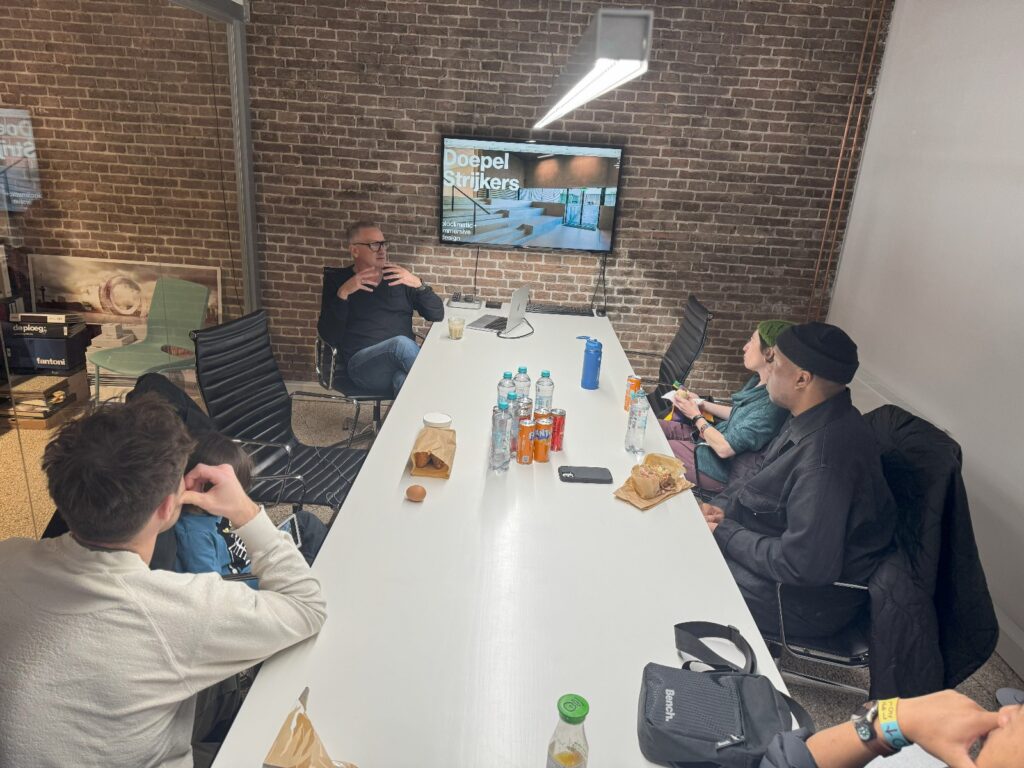
Meeting with Duzan Doepel , Co-Founder of Doepel Strijkers
(Photo: CCM)
MARCH 20: ROTTERDAM
Today’s visit with MVRDV underscored the urgent need to integrate climate resilience into innovative urban solutions. Their recent publication, the “Sea Level Rise Catalogue,” serves as both a necessary and inspirational toolkit, offering examples of new flood-resilient typologies. This work aligns with the broader framework of climate-resilient cities—urban areas designed to adapt to, withstand, and recover from the impacts of climate change. The catalogue provides design solutions for infrastructure and housing that can endure extreme weather, protecting inhabitants from harm. It also highlights strategies to ensure economic stability by maintaining economic activities even during climate disruptions, safeguarding businesses and livelihoods. Additionally, the catalogue showcases cities that incorporate renewable energy sources, green building materials, and efficient public transportation systems, reducing their overall carbon footprint. By proposing green spaces, clean air, and efficient public services, the designs aim to enhance the quality of life for residents. As climate risks intensify, resilient cities will be better prepared for future challenges, ensuring long-term viability.
A second theme explored during the visit was “What if NL 2100,” a visionary project imagining the Netherlands in the year 2100. Given the country’s unique geography—much of which lies below sea level—this speculative vision is critical for understanding how the nation can adapt and thrive amid climate-related challenges. By embracing innovative solutions, the Netherlands can not only survive but flourish in the face of climate change. MVRDV’s forward-thinking approach plays a significant role in shaping this vision, ensuring a resilient, sustainable, and vibrant future for all.
Finally, Maria Stamati introduced us to MVRDV’s Rooftop Catalog, which reimagines the potential of urban rooftops. This initiative aims to utilize underused spaces for social, environmental, and economic benefits. The catalogue serves as a practical guide, showcasing a variety of rooftop transformations that help cities adapt to climate change, increase biodiversity, and improve urban living.
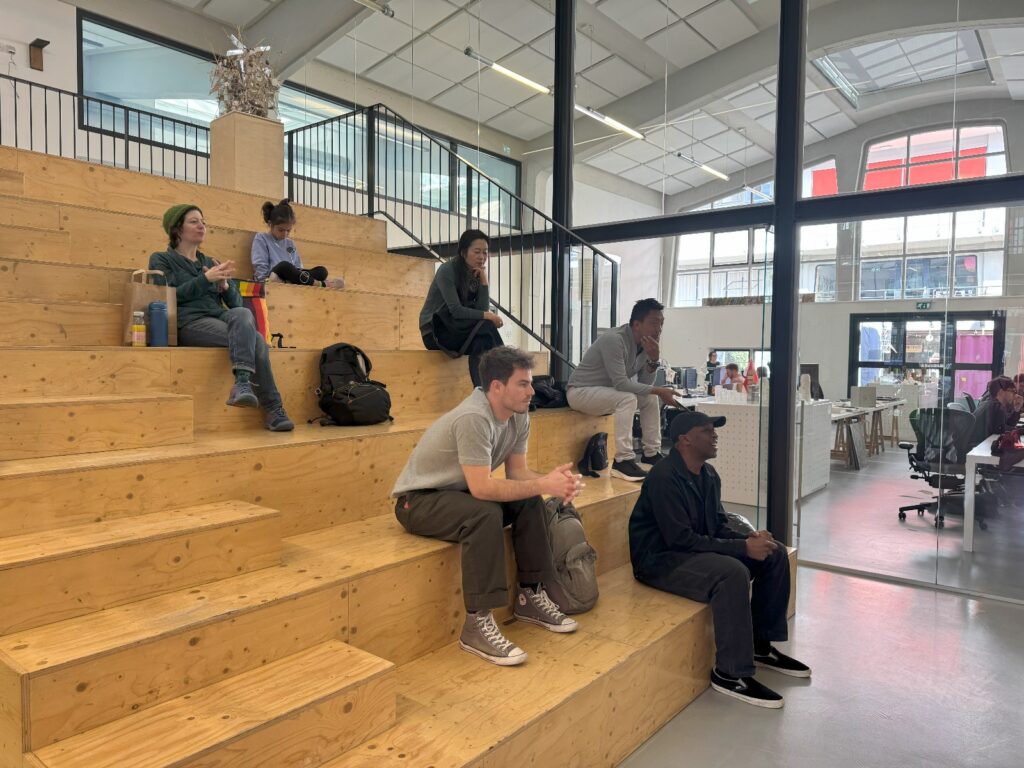
In the afternoon, we visited SAWA, a project by Mei Architects in Rotterdam’s Lloydkwartier district. Walking from MVRDV’s office to SAWA, we passed through off-the-beaten-path neighborhoods filled with community creations, urban gardens, community hubs, 1:1 installations, and resting spots for people to enjoy. Many of these spaces are repurposed marginal areas that have yet to be developed.
At 3 PM, we arrived at SAWA, a groundbreaking project that exemplifies the future of sustainable urban living. Located in the dynamic Lloydkwartier district, SAWA combines innovative design, environmental responsibility, and community-oriented living to create a model for resilient and inclusive cities. By prioritizing sustainability, health, and social connection, SAWA sets a new benchmark for residential architecture, demonstrating how thoughtful design can address the challenges of urbanization and climate change. Mei Architects has integrated a participatory approach into the design and development process, ensuring the project not only meets the needs of its future residents but also fosters a sense of ownership and connection among them. This participatory element is central to SAWA’s mission of creating a socially inclusive, sustainable, and community-driven living environment.
MARCH 21: AMSTERDAM
During a stop in Amsterdam Sloterdijk, with some free time to spare, we stumbled upon a hidden gem that immediately caught our attention: De Tuin van Bret. Nestled amidst gleaming skyscrapers, this sustainable village is a testament to the ingenuity of a group of visionary entrepreneurs. Here, trade, relaxation, and even tending to chickens and vines coexist harmoniously. It’s an oasis of creativity and sustainability that we were thrilled to discover by chance.
One of the driving forces behind this project is Khoi Tran, a creative mind who, through inclusion and collaboration, is bringing his dream to life. De Tuin van Bret is a space for co-creation, learning, and sharing, with a focus on minimal environmental impact and maximum experiential and community engagement. This initiative is a shining example of a new economic model—one that prioritizes beautiful, high-quality, and sustainable creations over monetary gain. It’s an inspiring project that fosters collective upliftment and points the way toward a better world.
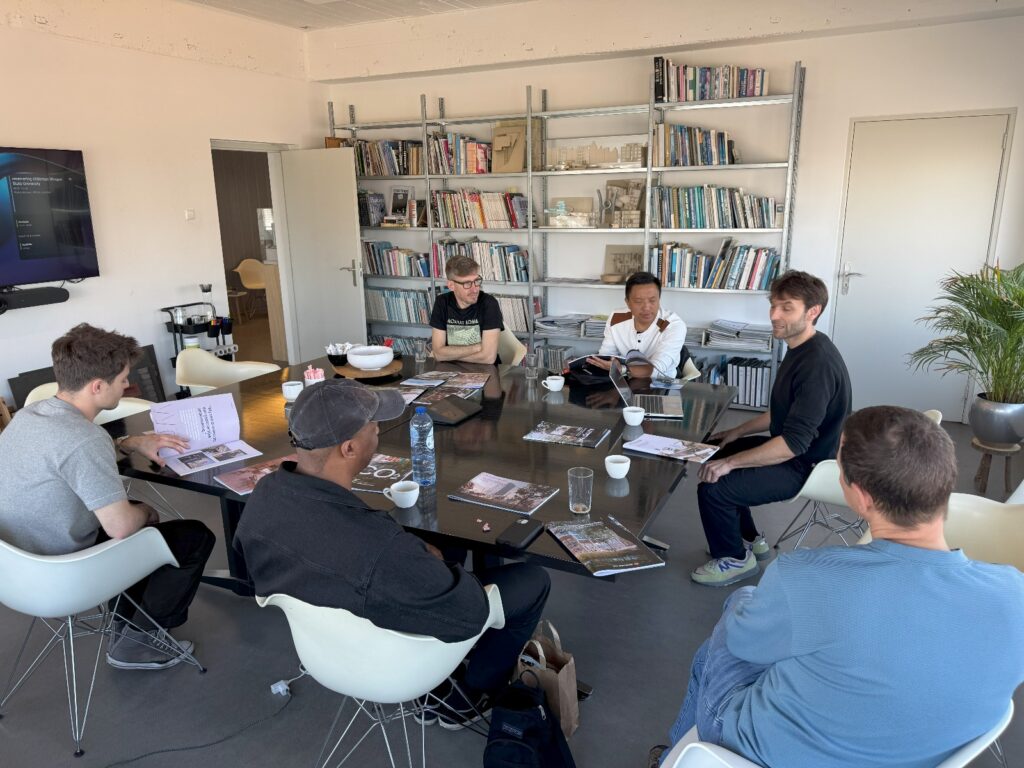
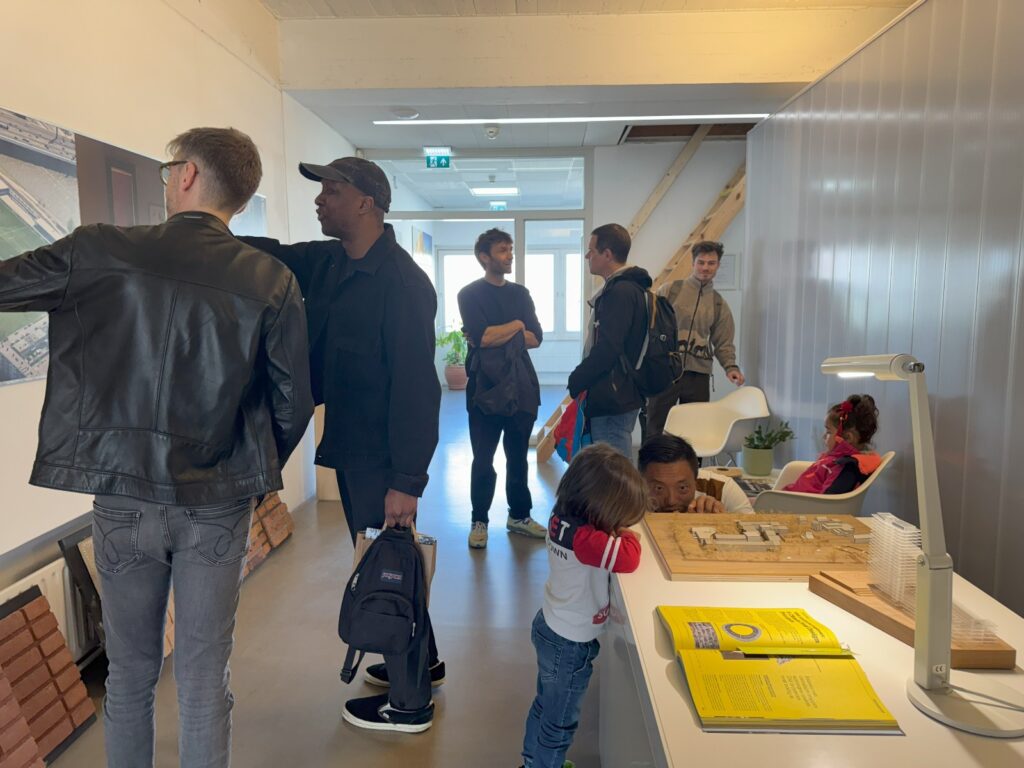
Later that morning, we arrived at wrk architects, where sustainability is not just an afterthought but the foundation of every project. From the outset, we were reminded that architects bear a responsibility to address the environmental and societal damage caused by their profession. The team at wrk architects is committed to minimizing these negative impacts, leveraging the knowledge, technology, and experience available today to create designs that are both pro-environment and pro-people.
The pressing question is: How will architects respond to the urgent need for climate-resilient cities? We are in the midst of a significant transition, and collaboration and sustainability are no longer optional—they are imperative. At wrk architects, the approach is clear: build a compelling narrative and offer no design options that deviate from sustainable principles. The entire office is trained to prioritize energy consumption reduction and understand the impact of every design decision.
The office operates in alignment with the UIA Climate Change Agendas, focusing on designs that prioritize people, circularity, reuse, and reduction. They are rethinking traditional business models and workflows to create a more sustainable future. Their design principles include:
- Practicing circular design throughout the entire process
- Using timber and bio-based materials as alternatives
- Building smarter by optimizing material use
- Drawing inspiration from the surrounding nature
- Targeting Paris Proof standards, aiming for carbon dioxide-free construction and zero CO2 emissions over a building’s entire lifecycle
Ben and Matteo from wrk architects took us to the Studentencomplex Amsterdam, a Duwo building originally designed by Dudok. After sitting vacant for years, it was repurposed and reoccupied in 2015. The transformation, led by wrk architects, breathed new life into the space. While it’s not a collective housing project, the design encourages social interaction. By relocating mailboxes to a central area, the architects created a hub for residents to gather, revitalizing previously unused spaces. The washrooms, crafted staircases, elevators, and corridors also serve as additional points of connection.
As a historical monument, the building required minimal intervention. Energy efficiency was improved through wall insulation, lowered ceilings in common areas, and strategically designed apartment layouts. A new row of windows enhanced natural light in the corridors, further elevating the quality of the space.
This experience reinforced the idea that a civilized society must integrate the environment into its design to ensure equity and long-term well-being. The projects we encountered in Amsterdam—De Tuin van Bret and the work of wrk architects—are powerful examples of how creativity, collaboration, and sustainability can come together to shape a better future.
How are you contributing to climate goals?
CONCLUSION
How has this trip helped us grow into more aware, sensitive, and intentional designers? This experience has shifted our perspective, making us more curious and engaged observers of people and places. While we come from a well-resourced country, we often lack critical insights, skills, technologies, and experiences. Most importantly, assuming that our resources will always be available to sustain our privileged lifestyles is an illusion. True growth happens when we open ourselves to different perspectives and engage as part of a collective. This is when design becomes truly meaningful—when we can explore solutions to current challenges in a global and holistic way. By nature, designers are optimistic, believing in their ability to shape a better world. However, this does not mean we are naive about the impact of our profession on the planet. We must make conscious choices, prioritize responsible sourcing, select sustainable materials, and ensure inclusivity. Our role is to co-create a built environment that is not only innovative but also sustainable and equitable for all.
THANK YOU — A special thank goes to the Baltimore Rotterdam Sister City Committee for always supporting Morgan State University School of Architecture + Planning students to participate in yet another successful trip to Rotterdam. Huge kudos to my friends and colleagues who help me discovering inspiring people and places, Matteo Bettoni and Maki Oishi. Thanks to the Gemeente Rotterdam (Rotterdam municipal government) for all the insight and constant support: Danny Nelemans, Emiel Arends, Hermen Borst, Karen van Spek, Marlies van der Maarel. Thanks to the sponsors who have generously provided funds to help cover the travel costs for the students. 2025 Sponsors include: Jeffrey Penza & Laura Thul Penza | BluePrint Café | brennan + company architects | Greenleaf Construction | Vectorworks | Twopoint Studio | Forbes Design Center | Custom Concepts by Greenwalt ArchPlan Inc.
References
CarbonLAB
groupa.nl/projects/carbonlab
CoWonen
cowonen.com
De Rotterdam
derotterdam.nl/en/
De Urbanisten
www.urbanisten.nl
Doepel Strijkers
doepelstrijkers.com
Endeavour
endeavours.eu/en
GroupA (Group for Architecture)
groupa.nl
MVRDV
www.mvrdv.com
Mei Architects
mei-arch.eu
mei-arch.eu/en/projects/sawa/
Morgan State University School of Architecture
www.morgan.edu/sap
Natrufied Architecture
www.natrufied.nl/
De Warren
www.archdaily.com/1001864/housing-cooperation-de-warren-natrufied-architecture
TU Delft Department of Landscape Architecture
www.tudelft.nl/bk/over-faculteit/afdelingen/urbanism/organisatie/secties/landscape-architecture/
TU Delft Centre for the Just City
just-city.org
Vakwerkhuis
vakwerkhuis.com
wrk architects
wrkarchitecten.nl/nl
wrkarchitecten.nl/nl/projecten/stedenbouwkundig-ontwerp-bomenbuurt-wormerveer
THANKS FOR YOUR SUPPORT:
– 2025 Student Trip Sponsors –
Platinum
Jeff and Laura Thul Penza
GOLD
Blueprint Café
Silver
brennan+company architects
Greenleaf Construction
Vectorworks
BRONZE
COPPER
– 2025 Student Trip Supporters –
DONORS
Joe and Margaret Cellucci
Susannah Bergmann and Dave Huber
Chesapeake Tile & Marble
